michael jackson invincible album zip
michael jackson invincible album zip michael jackson invincible album zip
michael jackson invincible album zip
  Home
michael jackson invincible album zip
  About Us
michael jackson invincible album zip
  Products
michael jackson invincible album zip
  Process Models
michael jackson invincible album zip
  SE Resources
michael jackson invincible album zip
  Commentary
michael jackson invincible album zip
  Contact us
michael jackson invincible album zip
Breaking News!

A new blog ...

Album Zip Updated — Michael Jackson Invincible

The centerpiece is Written after a water balloon fight with children in Germany, the track is a cappella at its beginning and end. It is a haunting, spiritual plea for love and silence. Without the distraction of heavy instrumentation, Jackson's voice takes center stage, revealing a weariness and purity that is deeply affecting. It connects the dots between the gospel roots of HIStory and the innocence of his childhood.

The album featured a posthumous appearance from The Notorious B.I.G. on "Unbreakable" and a guitar solo by Carlos Santana on "Whatever Happens".

Tracks like "Privacy" and "2 Bad" (from previous eras, though mirrored in style here) showed Jackson fighting back against media scrutiny. On Invincible , "Privacy" features a gritty guitar solo by Slash, while the title track "Invincible" utilizes heavy, stuttering drum programming designed to shatter club sound systems. michael jackson invincible album zip

: The lead single reached #10 on the Billboard Hot 100 and featured a star-studded short film with Marlon Brando and Chris Tucker. Modern Sound

Absolutely. While it lacks the narrative cohesion of Thriller or the raw edge of Bad , Invincible is Michael Jackson unshackled—experimenting with futuristic R&B, addressing his deepest insecurities, and proving that at 43, his voice could still shatter glass. The centerpiece is Written after a water balloon

Following the release of HIStory: Past, Present and Future, Book I (1995) and the remix project Blood on the Dance Floor (1997), Michael Jackson set out to create an album that would firmly establish his relevance in the new millennium. Production began in 1997 and spanned nearly four years, making it one of the most protracted and expensive recording projects in music history, with costs estimated at upwards of $30 million.

A well-curated digital album includes track numbers, lyrics, and the iconic multi-colored cover art. Supporting the King of Pop It connects the dots between the gospel roots

Owning the CD or the recent vinyl reissues provides a tactile experience that digital files can't match.

However, the album's potential was severely hampered by a well-documented dispute between Michael Jackson and Sony Music. Jackson alleged that Sony did not provide proper marketing and, for the first time in his career, failed to release a planned string of singles, which halted the album's momentum. 4. Legacy: "Invincible" Turns 20 and Beyond

Despite debuting at number one on the Billboard 200 and selling millions of copies worldwide, Invincible was overshadowed by a massive public dispute between Michael Jackson and Sony Music Entertainment. Jackson refused to tour for the album, and Sony subsequently ceased promotion, cutting short the commercial life of what was intended to be a multi-single campaign.

In retrospect, music critics and fans have thoroughly re-evaluated Invincible . While contemporary reviews in 2001 were mixed, modern audiences view the album as a visionary blueprint for 2000s R&B and pop. The intricate vocal layering and experimental sound design heavily influenced the next generation of pop innovators, from Justin Timberlake to The Weeknd. The Modern Digital Footprint


 
The newest edition!
michael jackson invincible album zip Just Released!
Another
novel by
Roger Pressman!
michael jackson invincible album zip
Now available from McGraw-Hill!
Available in trade paperback and e-book editions. For more information, click here.

The seventh edition of Software Engineering: A Practitioner's Approach is intended to serve as a guide to a maturing engineering discipline. The seventh edition, like the six editions that preceded it, is intended for both students and practitioners, retaining its appeal as a guide to the industry professional and a comprehensive introduction to the student at the upper level undergraduate or first year graduate level.

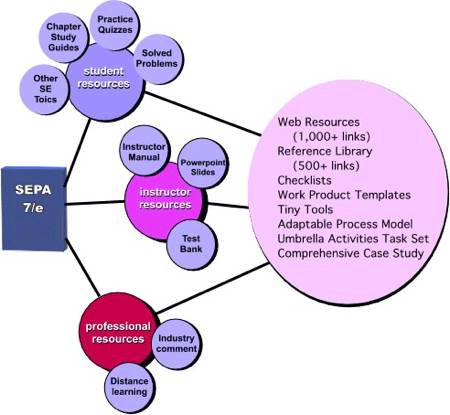
The seventh edition is considerably more than a simple update. The book has been revised and restructured to improve pedagogical flow and emphasize new and important software engineering processes and practices. In addition, a revised and updated “support system,” illustrated below, provides a comprehensive set of student, instructor, and professional resources to complement the content of the book.

michael jackson invincible album zip
The 32 chapters of the seventh edition have been reorganized into five parts. This organization, which differs considerably from the sixth edition, has been done to better compartmentalize topics and assist instructors who may not have the time to complete the entire book in one term.

Part 1, The Process, presents a variety of different views of software process, considering all important process models and addressing the debate between prescriptive and agile process philosophies. Part 2, Modeling, presents analysis and design methods with an emphasis on object-oriented techniques and UML modeling. Pattern-based design and design for Web applications are also considered. Part 3, Quality Management, presents the concepts, procedures, techniques, and methods that enable a software team to assess software quality, review software engineering work products, conduct SQA procedures, and apply an effective testing strategy and tactics. In addition, formal modeling and verification methods are also considered. Part 4, Managing Software Projects, presents topics that are relevant to those who plan, manage, and control a software development project. Part 5, Advanced Topics, considers software process improvement and software engineering trends. Continuing in the tradition of past editions, a series of sidebars is used throughout the book to present the trials and tribulations of a (fictional) software team and to provide supplementary materials about methods and tools that are relevant to chapter topics. Two new appendices provide brief tutorials on UML and object-oriented thinking for those who may be unfamiliar with these important topics.

The five-part organization of the seventh edition enables an instructor to "cluster" topics based on available time and student need. An entire one-term course can be built around one or more of the five parts. A software engineering survey course would select chapters from all five parts. A software engineering course that emphasizes analysis and design would select topics from Parts 1 and 2. A testing-oriented software engineering course would select topics from Parts 1 and 3, with a brief foray into Part 2. A "management course" would stress Parts 1 and 4. By organizing the seventh edition in this way, I have attempted to provide an instructor with a number of teaching options.
Software Engineering: A Practitioner's Approach
7th Edition
Table of Contents

Chapters

1. Software and Software Engineering

Part I - Process

2. Process Models
3. Agile Development

Part II - Modeling

4. Practice: A Generic View
5. Understanding Requirements (new chapter)
6. Requirements Modeling: Scenarios and Data (new chapter)
7. Requirements Modeling: Flow, Classes, and Behavior (new chapter)
8. Design Concepts (new chapter)
9. Architectural Design
10. Component-Level Design
11. Usability design (new chapter)
12. Pattern-based Design (new chapter)
13. WebApp Design

Part III - Quality Management

14. Quality Concepts (new chapter)
15. Software reviews (new chapter)
16. Software Quality Assurance
17. Software Testing Strategies
18. Testing Methods for Conventional Software (new chapter)
19. Testing Methods for OO Software (new chapter)
20. Testing Methods for WebApps
21. Advanced Verification Methods (new chapter)
22. Software Configuration Management
23. Product Metrics

Part IV - Project Management

24. Management Concepts
25. Process and Project Metrics
26. Estimation
27. Scheduling
28. Risk Management
29. Maintenance and Reengineering (new chapter)

Part V-Advanced Topics

30. Software Process improvement (new chapter)
31. Emerging Trends in Software Engineering (new chapter)
32. The Road Ahead
Appendix I - UML Tutorial (new)
Appendix II - OO Concepts (new)


Home About us Products Product Models SE Resources Commentary Contact us
Web site and all contents © 2001-2009, R.S. Pressman & Associates, Inc., All rights reserved.
Free website templates